
Perhaps this is cheating, but just a little. London is the far away place I have visited most often; I am not sure how many times, but it's likely more than the number of fingers and toes I have to count with. A few years ago, I wrote an account of one of those visits. The one on September 11, 2001. It fits the theme of the Far Away Places series so I thought I would just offer it again, exactly as it appeared for the first time.
Dreadful
"We've just heard news from the States; apparently something dreadful has happened." And indeed it had.
We walked across the little park with the gazebo, an oasis in front of the engineering building at City University London. It was, and still is, all the campus there is at this university that is more scattered than sprawling, buildings hither and yon in this area on the east side of London. I was here to participate in the biannual International Conference on Compressors and Their Systems; Shirley, as she had been at previous conferences, was with me. As we mounted the stairs in front of the classroom building to greet the conference chairman and his wife, we were met with the pronouncement of dreadful goings on back home.
A tour and dinner were on the agenda for this evening, starting with a boat trip on the Thames and a visit to the London Eye before gathering at the headquarters building of the Institution of Mechanical Engineers (IMechE) at One Birdcage Walk. The architect for the London Eye project was to give an informal accounting of his experiences during its design and construction before we gathered for a light meal.
We did in fact take the boat tour; a few of our British hosts were making calls on their cell phones, but details of what had happened across the Atlantic were hard to come by. The London Eye had closed out of security concerns. The skies over downtown London, normally busy with planes approaching Heathrow from the east, were quiet. Our guest speaker sent his regrets, but informed us he had friends in New York City and was trying desperately to reach them.
It was only when we retired to the reception area of the IMechE offices that we saw in the horrific detail made possible by modern video technology the terror that was visited upon the people of New York and Washington; the tragic story of heroism aboard United Airlines flight 93 would unfold later.
Later, Shirley and I got in touch with our daughters to discover that they had thought we were planning to be flying home on this day. We were mutually relieved to be able to confirm that all were well.
I called American Airlines about our September 13th flight. Not surprisingly, there was little information to be had. The next day I was told it would probably be Tuesday, Sept. 18, before we would be able to return home. The agents I talked to were noticeably and understandably upset. The agent I spoke to on Thursday broke down in tears. I talked to her a bit, told her I honestly could not fully appreciate the pressure under which she was working, and thanked her for just being there for those of us trying to get back home. It was this call that convinced me to accept the Tuesday departure. I did not call again. It just seemed unfair to the agents who were struggling so mightily with the task of getting everyone back while trying to deal with their loss as well. Also, I knew from the news that many of the stranded were far worse off than we were, having as we did a hotel to sleep in and no shortage of places to eat.
The people of London treated us kindly. Our hotel offered us the reduced rate arranged for conference guests for the duration of our stay. The Turkish family who ran the tiny café across the street where we had most of our breakfasts provided coffee at no extra charge. A more upscale fish restaurant offered free appetizers. One young man stopped us on the street and said, “Hey Yank. We’re behind you all the way. Hope you get the b------s that did it!”
We discovered a small restaurant in Embankment Park, a short walk from the tube stop through a flower-bedecked green space. Sitting outside under a glorious tree that sheltered the entire patio area, one could escape, briefly, the unthinkable awfulness of Tuesday, September 11, 2001. And, at the same time, reflect on the fact that you know you would never forget it.
Wouldn't it be nice if no one ever had to the hear the words, "Something dreadful has happened in..." again?
Showing posts with label Far Away Places. Show all posts
Showing posts with label Far Away Places. Show all posts
Tuesday, April 24, 2012

Saturday, April 7, 2012
Far Away Places #4
Osaka, Japan
As it so happened, it was on a business trip to Japan that I was able to demonstrate Bushu-suru. Let me explain…
In the way of many businesses, leaders where I worked and at a company in Japan decided it would make sense to enter into some sort of cooperative agreement. My role was to work with Hiroyuki, an engineer working in Osaka. Our task was to evaluate each other's compressors and render opinions as to the possibility of each company manufacturing and/or using the other's in their products.
Hiroyuki came to La Crosse and we spent time together in the office and the laboratory, discussing features of the compressors we were comparing and making plans for operational tests and other engineering evaluations. During his stay, he came down with a bad cold and we explored the local Walgreen's. This was a foreshadowing of things to come during my subsequent visit to Osaka, as it would turn out.
So, some months after Hiroyuki left La Crosse, I made the long trip to Osaka, my first and only visit to Asia. The plan was for me to visit the offices and factory, getting an introduction to the company; a few others who had visited the facilities before, would come a couple of days later.
Getting to the hotel from the airport was a breeze as all of the signs in the airport and on the train I took were in English as well as Japanese. Same at the hotel. For example, I encountered this warning in the bathroom in my room: "Avoid contact with water. Danger of electric shock." This advice was, mind you, on the combination toilet/bidet seat. Nonetheless, I appreciated the fact that the warning was provided in my native language so I could… OK, that's another story altogether.
The next morning, Hiroyuki met me at the hotel and led me to the nearest subway stop for the ride out to his office. As we went down into the station it became obvious that the coddling of non-Japanese speaking tourists was over. As far as I could tell, all signs were in Japanese only. Like this one:
 Now what essential advice do you suppose we are being provided here? Right, I don't know either. I'm sure some of the signs said "Exit," "To the Trains" and "Tickets." Or perhaps there were things here that I should not allow to get wet lest I suffer some dire consequences which were described on the warning. I'll never know. What I did was grab ahold of Hiroyuki's coat. Tightly. For the duration of the ride.
The factory tour was interesting, but I was feeling progressively less well as the morning wore on. When we returned to the office, my stomach was in full protest to the effects of the long flight and 13 hour time difference. Coffee, water and light refreshments were offered in the conference room set aside for the meetings, but there was no way. Rather, I suddenly became very ill, right there in the meeting room. A few things were demonstrated by this. One was that it is not possible for embarrassment to be fatal. I am sure of that, since I am, after all, writing this account many years after the fact.
But more to the point, I got to see first hand just how kind and considerate my hosts were. Several people came to my aid, expressing great concern over my well-being and insisting that I not concern myself with cleaning up as they were already on the task. In fact, they escorted me to the director's office where I was able to use his private washroom then lie down on the sofa in one part of the large room.
It was only a short time later when I began to feel a little better and volunteered to continue with the meetings. They had other plans, however. Hiroyuki escorted me to the office of the on site company doctor who prescribed some medications which I picked up at the on site company pharmacy adjacent to his office. I was then escorted to the reception area where a company car was waiting to take me back to the hotel.
Every hour that passed found me feeling better and that evening I was even able to confront an appetizer of octopus and other seafood delights at the hotel restaurant. I didn’t order it, of course, but just being able to consider it represented significant improvement.
So, I hung in and the rest of the trip went well. There was, in the end, no agreement for the kind of cooperation envisioned early on and I have not seen Hiroyuki since those few days in Osaka.
As you might remember, much the same thing happened to President George H. W. Bush in 1992 at a banquet at the home of the Japanese Prime Minister. Accounts of this event include references to the fun that late night comedians had with it. It was even a joke in an episode of The Simpsons. Years later, there were references to what became known as Bushu-suru, meaning "to do the Bush thing."
It's too bad that humor (and ridicule) are what seem to have been the primary reactions to that unfortunate event. Because my experience showed me the kindness and concern of the people I was with that day.
Epilogue
During his stay in La Crosse, Hiroyuki told me about "Yamato Damashii," which he said meant "Never Give Up Spirits!" It was the idea that you should not give up in the face of adversity. He had a headband with the words written on it and he wrote out the characters on a paper napkin. You know, in case I wanted to get a tattoo someday.
Seriously, it has not been an easy time for the people of Japan. I can only guess, but perhaps the concept of Yamato Damashii is an encouragement as they struggle to rebuild and I would also guess Hiroyuki would offer it as such. So, here it is, in his hand:

As it so happened, it was on a business trip to Japan that I was able to demonstrate Bushu-suru. Let me explain…
In the way of many businesses, leaders where I worked and at a company in Japan decided it would make sense to enter into some sort of cooperative agreement. My role was to work with Hiroyuki, an engineer working in Osaka. Our task was to evaluate each other's compressors and render opinions as to the possibility of each company manufacturing and/or using the other's in their products.
Hiroyuki came to La Crosse and we spent time together in the office and the laboratory, discussing features of the compressors we were comparing and making plans for operational tests and other engineering evaluations. During his stay, he came down with a bad cold and we explored the local Walgreen's. This was a foreshadowing of things to come during my subsequent visit to Osaka, as it would turn out.
So, some months after Hiroyuki left La Crosse, I made the long trip to Osaka, my first and only visit to Asia. The plan was for me to visit the offices and factory, getting an introduction to the company; a few others who had visited the facilities before, would come a couple of days later.
Getting to the hotel from the airport was a breeze as all of the signs in the airport and on the train I took were in English as well as Japanese. Same at the hotel. For example, I encountered this warning in the bathroom in my room: "Avoid contact with water. Danger of electric shock." This advice was, mind you, on the combination toilet/bidet seat. Nonetheless, I appreciated the fact that the warning was provided in my native language so I could… OK, that's another story altogether.
The next morning, Hiroyuki met me at the hotel and led me to the nearest subway stop for the ride out to his office. As we went down into the station it became obvious that the coddling of non-Japanese speaking tourists was over. As far as I could tell, all signs were in Japanese only. Like this one:
 Now what essential advice do you suppose we are being provided here? Right, I don't know either. I'm sure some of the signs said "Exit," "To the Trains" and "Tickets." Or perhaps there were things here that I should not allow to get wet lest I suffer some dire consequences which were described on the warning. I'll never know. What I did was grab ahold of Hiroyuki's coat. Tightly. For the duration of the ride.
The factory tour was interesting, but I was feeling progressively less well as the morning wore on. When we returned to the office, my stomach was in full protest to the effects of the long flight and 13 hour time difference. Coffee, water and light refreshments were offered in the conference room set aside for the meetings, but there was no way. Rather, I suddenly became very ill, right there in the meeting room. A few things were demonstrated by this. One was that it is not possible for embarrassment to be fatal. I am sure of that, since I am, after all, writing this account many years after the fact.
But more to the point, I got to see first hand just how kind and considerate my hosts were. Several people came to my aid, expressing great concern over my well-being and insisting that I not concern myself with cleaning up as they were already on the task. In fact, they escorted me to the director's office where I was able to use his private washroom then lie down on the sofa in one part of the large room.
It was only a short time later when I began to feel a little better and volunteered to continue with the meetings. They had other plans, however. Hiroyuki escorted me to the office of the on site company doctor who prescribed some medications which I picked up at the on site company pharmacy adjacent to his office. I was then escorted to the reception area where a company car was waiting to take me back to the hotel.
Every hour that passed found me feeling better and that evening I was even able to confront an appetizer of octopus and other seafood delights at the hotel restaurant. I didn’t order it, of course, but just being able to consider it represented significant improvement.
So, I hung in and the rest of the trip went well. There was, in the end, no agreement for the kind of cooperation envisioned early on and I have not seen Hiroyuki since those few days in Osaka.
As you might remember, much the same thing happened to President George H. W. Bush in 1992 at a banquet at the home of the Japanese Prime Minister. Accounts of this event include references to the fun that late night comedians had with it. It was even a joke in an episode of The Simpsons. Years later, there were references to what became known as Bushu-suru, meaning "to do the Bush thing."
It's too bad that humor (and ridicule) are what seem to have been the primary reactions to that unfortunate event. Because my experience showed me the kindness and concern of the people I was with that day.
Epilogue
During his stay in La Crosse, Hiroyuki told me about "Yamato Damashii," which he said meant "Never Give Up Spirits!" It was the idea that you should not give up in the face of adversity. He had a headband with the words written on it and he wrote out the characters on a paper napkin. You know, in case I wanted to get a tattoo someday.
Seriously, it has not been an easy time for the people of Japan. I can only guess, but perhaps the concept of Yamato Damashii is an encouragement as they struggle to rebuild and I would also guess Hiroyuki would offer it as such. So, here it is, in his hand:

Saturday, March 3, 2012
Far Away Places #3(b)
St. Petersburg, Russia
As I am sure you can imagine, bickering between the US and USSR provided ample opportunity for those so inclined to practice espionage, subterfuge and other forms of mischief. And while my visit to this beautiful city on the Neva River took place about 6 years after what is generally considered to be the end of the Cold War, I engaged in a bit of sneaking around myself. It wasn't quite up to the standards of James Bond or George Smiley, but I did manage to go undetected until I decided to just give myself up. Here's the story:
Cancelation of a planned visit to a local compressor manufacturing facility provided a day off to explore a bit of St. Petersburg and its environs. It was Olga's turn tobabysit accompany us on our explorations and she met us at our hotel in the morning. We were going to take a hydrofoil out to Emperor Peter the Great's summer palace, the trip on the high speed water craft being one of the attractions of the visit. Light rain was falling and we suggested taking a cab to the pier, but Olga said it was not so far and we could just walk. It was about two miles.
When we got to the dock, we were informed that the boat was not running because, well, because it wasn't. It might be making trips again tomorrow. But maybe not. That's the way Olga explained it. She said a lot of services in the city were like that – hit or miss. You just have to show up and take (or not) what you find. We set off on another short walk, only a mile this time, to a central bus staging area. Olga suggested we give her some money which she would use to purchase our tickets. When it was time to leave, she took us aside and said that we should not talk while we were on the bus. "Why is that?" I asked. She said, "I bought resident tickets. If they hear you speaking English, then they will know you are tourists and charge you the higher price for tourist tickets."
I was thinking it wouldn't have been any more obvious that we were Americans if we'd have had Old Glory tattooed on our foreheads. But, we did as we were told and kept our mouths shut. As the bus pulled out of the station, a lady got up at the front, took out a microphone and started talking to us. It soon became evident that we were not on a regular transit bus, but were now members of a tour group.
Without a clue as to what we were being told, we rode in silence. Once at the palace, we disembarked and our guide starting waving everyone into a group. She then motioned to Olga and took her aside for a private conversation. Olga came back and told us, "The guide knows you are tourists." Well that was a shock. So, we were busted. But not so fast…
It turns out that the guide also told Olga that she had a plan. It seems beating the system is a popular pastime in Russia and our guide rose to the challenge of getting us into the palace without having to pay the "tourist price." She called our tour group, about a dozen in addition to us, and had them gather together in a cluster, with us in the center. What we had to do was to get past the babushkas – meaning grandmothers or old ladies; that's what she called them. They collected the tickets and would turn us in if they saw we were trying to get in at resident prices. The group shuffled through the gate, looking like a giant, single-celled organism with the Americans and their Russian co-conspirator forming the nucleus. And you know what? It worked. We had been successfully smuggled into the palace grounds and were now free to wander around the spectacular gardens. Our guide conducted the tour and Olga translated, but only when she was sure no one outside our group would overhear her. Because if they did, they would certainly tell the authorities and we would have to pay the "tourist" price.
Still, it seemed as the situation was a little less restrictive and we enjoyed the walk immensely. Then, it was time to start the tour of the palace. And wouldn't you know, our guide was not allowed to conduct the tour as there were special guides provided for that. So once again Olga tells us that she cannot translate and we cannot talk to each other while inside, lest we are found out and end up having to pay the "tourist" price.
We decide that maybe there is another way. We ask Olga if we could just buy tourist tickets and then not have to skulk around in silence for the rest of the day. She said that we could to that and, except for the extra money we would have to come up with, it wouldn't be a problem. "How much are we talking about?" I asked her. "Two hundred roubles." That was about $5. "So, if we pay $5 and get tourist tickets, then you can translate during the tour and we can talk to each other and not have to worry about being carted off to some Gulag for the rest of our lives?" I didn't really say that last bit. But I'd been thinking that it was a possibility, given our nefarious behavior. "Sure," she replied. We bought the tickets, thus ending our little gambit and certainly avoiding a nasty international incident.
It was a spectacular place and we had an interesting and informative tour. It was about 2 p.m. when we finally left the palace for a last brief stroll around the gardens. We had not had anything to eat since our early breakfast and we inquired as to the possibility of lunch or at least a snack. Olga responded by digging around in her purse and pulling out an orange. She peeled it, broke it into thirds and gave the two of us our share. Lunch.
A few hours later, the bus was approaching the stop in the city and we asked Olga if she would join us for dinner. "No thank you," she said. "Why not?" "I don’t have any money," she replied. And it all fell into place. Walking to the dock and bus stop, tourist tickets, sneaking into the palace, a single orange for three. She was taking care of us, and doing it with what she had.
We ate at the Chaika, a restaurant whose name translates as Seagull. Olga told us that she lived at home with her parents, a brother and an uncle. Her father, uncle and brother were engineers, but only her uncle was employed. She was studying engineering, but it was not at all certain that she would find a job when she graduated. They had very little, although the "non-tourist" prices were quite a bit below what we saw as Americans. In addition to having little money, there were shortages of consumer goods of all sorts. Kirill had told us earlier that many people carried around lists of clothing sizes for all of their family members on the chance that they would stumble upon a shop that actually had something on its shelves.
When the bread came before we were served our meals, Olga took her share, wrapped it in a napkin and put it in her purse. She also had a large portion of her meal boxed up to take home for her family. It seemed it was something she did, taking care of others. Maybe she had to do it for her family, but not for us.
I know where Kirill is as I see him every other year at the International Compressor Engineering Conference at Purdue. But it has been years since I have heard from Olga. I hope it worked out well for her.
Here are some of my pictures from St. Petersburg. While it might have been a little rough around the edges in 1996, it was a beautiful city. I guess it still is, actually.
The Compressor Conference in St. Petersburg
With Professor Yuri Glaerkin, our host

Here we are with Kirill and Olga

He Made His Own Pressure Transducers

Banquet - The Scene of the Too-Short Speech

Around the City
Our Hotel


At the Summer Palace


Next: The land of the rising sun.
As I am sure you can imagine, bickering between the US and USSR provided ample opportunity for those so inclined to practice espionage, subterfuge and other forms of mischief. And while my visit to this beautiful city on the Neva River took place about 6 years after what is generally considered to be the end of the Cold War, I engaged in a bit of sneaking around myself. It wasn't quite up to the standards of James Bond or George Smiley, but I did manage to go undetected until I decided to just give myself up. Here's the story:
Cancelation of a planned visit to a local compressor manufacturing facility provided a day off to explore a bit of St. Petersburg and its environs. It was Olga's turn to
When we got to the dock, we were informed that the boat was not running because, well, because it wasn't. It might be making trips again tomorrow. But maybe not. That's the way Olga explained it. She said a lot of services in the city were like that – hit or miss. You just have to show up and take (or not) what you find. We set off on another short walk, only a mile this time, to a central bus staging area. Olga suggested we give her some money which she would use to purchase our tickets. When it was time to leave, she took us aside and said that we should not talk while we were on the bus. "Why is that?" I asked. She said, "I bought resident tickets. If they hear you speaking English, then they will know you are tourists and charge you the higher price for tourist tickets."
I was thinking it wouldn't have been any more obvious that we were Americans if we'd have had Old Glory tattooed on our foreheads. But, we did as we were told and kept our mouths shut. As the bus pulled out of the station, a lady got up at the front, took out a microphone and started talking to us. It soon became evident that we were not on a regular transit bus, but were now members of a tour group.
Without a clue as to what we were being told, we rode in silence. Once at the palace, we disembarked and our guide starting waving everyone into a group. She then motioned to Olga and took her aside for a private conversation. Olga came back and told us, "The guide knows you are tourists." Well that was a shock. So, we were busted. But not so fast…
It turns out that the guide also told Olga that she had a plan. It seems beating the system is a popular pastime in Russia and our guide rose to the challenge of getting us into the palace without having to pay the "tourist price." She called our tour group, about a dozen in addition to us, and had them gather together in a cluster, with us in the center. What we had to do was to get past the babushkas – meaning grandmothers or old ladies; that's what she called them. They collected the tickets and would turn us in if they saw we were trying to get in at resident prices. The group shuffled through the gate, looking like a giant, single-celled organism with the Americans and their Russian co-conspirator forming the nucleus. And you know what? It worked. We had been successfully smuggled into the palace grounds and were now free to wander around the spectacular gardens. Our guide conducted the tour and Olga translated, but only when she was sure no one outside our group would overhear her. Because if they did, they would certainly tell the authorities and we would have to pay the "tourist" price.
Still, it seemed as the situation was a little less restrictive and we enjoyed the walk immensely. Then, it was time to start the tour of the palace. And wouldn't you know, our guide was not allowed to conduct the tour as there were special guides provided for that. So once again Olga tells us that she cannot translate and we cannot talk to each other while inside, lest we are found out and end up having to pay the "tourist" price.
We decide that maybe there is another way. We ask Olga if we could just buy tourist tickets and then not have to skulk around in silence for the rest of the day. She said that we could to that and, except for the extra money we would have to come up with, it wouldn't be a problem. "How much are we talking about?" I asked her. "Two hundred roubles." That was about $5. "So, if we pay $5 and get tourist tickets, then you can translate during the tour and we can talk to each other and not have to worry about being carted off to some Gulag for the rest of our lives?" I didn't really say that last bit. But I'd been thinking that it was a possibility, given our nefarious behavior. "Sure," she replied. We bought the tickets, thus ending our little gambit and certainly avoiding a nasty international incident.
It was a spectacular place and we had an interesting and informative tour. It was about 2 p.m. when we finally left the palace for a last brief stroll around the gardens. We had not had anything to eat since our early breakfast and we inquired as to the possibility of lunch or at least a snack. Olga responded by digging around in her purse and pulling out an orange. She peeled it, broke it into thirds and gave the two of us our share. Lunch.
A few hours later, the bus was approaching the stop in the city and we asked Olga if she would join us for dinner. "No thank you," she said. "Why not?" "I don’t have any money," she replied. And it all fell into place. Walking to the dock and bus stop, tourist tickets, sneaking into the palace, a single orange for three. She was taking care of us, and doing it with what she had.
We ate at the Chaika, a restaurant whose name translates as Seagull. Olga told us that she lived at home with her parents, a brother and an uncle. Her father, uncle and brother were engineers, but only her uncle was employed. She was studying engineering, but it was not at all certain that she would find a job when she graduated. They had very little, although the "non-tourist" prices were quite a bit below what we saw as Americans. In addition to having little money, there were shortages of consumer goods of all sorts. Kirill had told us earlier that many people carried around lists of clothing sizes for all of their family members on the chance that they would stumble upon a shop that actually had something on its shelves.
When the bread came before we were served our meals, Olga took her share, wrapped it in a napkin and put it in her purse. She also had a large portion of her meal boxed up to take home for her family. It seemed it was something she did, taking care of others. Maybe she had to do it for her family, but not for us.
I know where Kirill is as I see him every other year at the International Compressor Engineering Conference at Purdue. But it has been years since I have heard from Olga. I hope it worked out well for her.
Here are some of my pictures from St. Petersburg. While it might have been a little rough around the edges in 1996, it was a beautiful city. I guess it still is, actually.
The Compressor Conference in St. Petersburg
With Professor Yuri Glaerkin, our host

Here we are with Kirill and Olga

He Made His Own Pressure Transducers

Banquet - The Scene of the Too-Short Speech

Around the City
Our Hotel

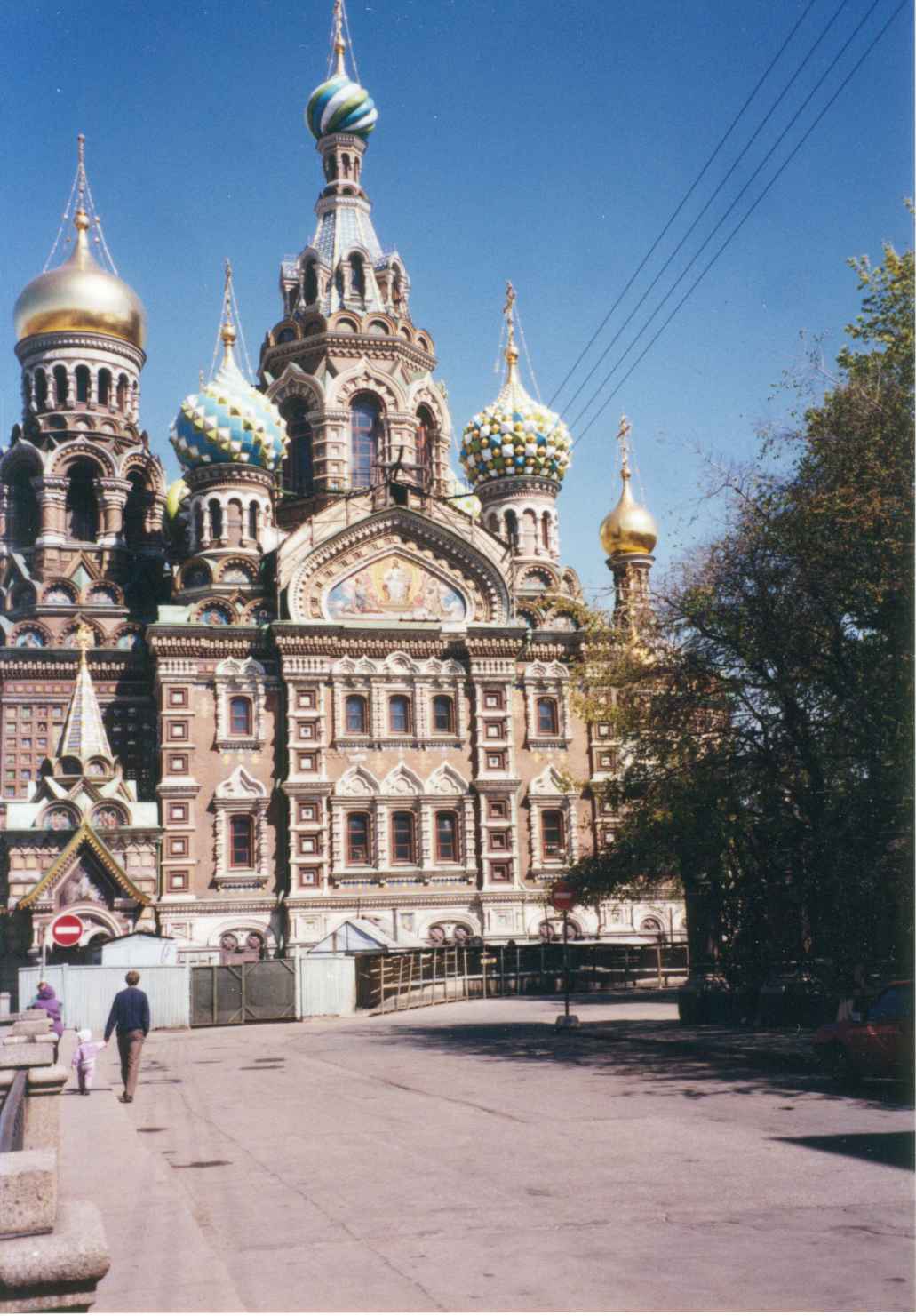


At the Summer Palace


Next: The land of the rising sun.
Tuesday, February 28, 2012
Far Away Places #3(a)
St. Petersburg, Russia
Raise your hand if you are well-read enough to know what these students are doing:
 OK, you can put your hands down now. If you said "duck and cover," then you know your 1950's history. The students are practicing getting to safety in the event of a nuclear attack from then arch-enemy, the USSR. Seriously, did we think that this would really work?
Now, if you are old enough to have actually participated in one of these drills, then you can sit back and take a nap as you are, like me, getting too old for all of this excitement.
That was the way it was during the cold war. Lots of posturing and sabre rattling. Times were tense, brinksmanship was defined in the Cuban Missile Crisis. The iron curtain went up. We knew who the enemy was. Eastern Europe was off limits.
Then, in 1989, the Berlin Wall came down, this followed by the dissolution of the USSR in 1991. In 1996, I had a chance to make a business trip to Russia. I had met Professor Yuri G. at a conference in Hannover, Germany and he invited me to visit the St. Petersburg State Technical University for a compressor conference. Two of us from Trane made the trip to see just what we might learn. From our former enemies. I really had that thought, what with having lived for more than 45 years in the environment of duck and cover, the Cuban Missile Crisis, and the Berlin Wall.
We stayed not too far from the University and had planned to take the subway to the conference. However, we were met at the hotel and taken by car. It seems the subway tunnel on the line had collapsed and there was a difficult-to-negotiate switching from subway-to-bus-to-subawy to get around the impediment. Turns out someone in city government decided to save money by shutting down a big refrigeration unit that ran all of the time. What they apparently missed was that the machinery was keeping the marshy ground around a section of the subway tunnel frozen. Once the ground thawed, it wasn't long before the cave in. In any event, we missed all of that and arrived at the university in style. Here's the name badge I was given. The bold letters in the center spell out my name phonetically in the Cyrillic alphabet. The CWA at the bottom is "USA" and the words just above that say "Trane Company."
 The conference was conducted in Russian and while the two students assigned to assist us during our stay – Kirill and Olga – whispered highlights during the sessions, we missed most of what was said. But, we had come to talk about work at the University and that went quite well. We met a number of people there, including an older professor (I'm that old now) who told us, among other things, how he would spend months making instruments that we could simply buy in large quantities for our work. Things were not easy for anyone we met during our visit.
When the conference was over, there was a banquet. This is apparently required of those hosting meetings in Russia. You WILL have a banquet for everyone to get together and celebrate the completion of the program. There were long tables with food and drink, lots of drink. As the meal was winding down, the president of the University got up and began to speak. Kirill told me that he didn't know much about compressors, but was hoping that we had found the conference valuable and thanked us for coming. He said more than that. A lot more. He talked long enough for most everyone at the tables to stop paying attention. But, when he was finally finished, he lifted his glass to offer a toast. Everyone in the room IMMEDIATELY stopped talking, took up their glasses drank the toast with him.
After this, Professor G. spoke. Kirill informed me that he was talking about highlights of the conference and saying how pleased he was at the quality of the papers and the interest showed by all of the attendees. And, as with the University president, he said a lot more. But he too eventually got to a stopping point and so raised his glass, a gesture that everyone had apparently been waiting for as they once again followed suit without hesitation.
A few more people, including some conference attendees, repeated this process and we were making quite a dent in the liquid refreshment that had been set out on the tables. At some point, I decided that I should get up and say a few words on behalf of the foreigners in attendance. I discussed this with Kirill who agreed it would be a fine idea. My plan was to say a few words and have Kirill translate. Then, I would bring out the full measure of my Russian vocabulary, and tell everyone in their language, "It has been very nice. Thank you very much. Cheers!" I thought it went quite well.
When I was done and I had sat back down in my seat, the professor whom I told you about earlier, the one who made the instruments, leaned over and whispered to me, "That was very good. But, it was SHORT!" Oh well, now I know. And I've been trying to make up for that too-short speech ever since.
That was a memorable moment, but it was the other things I learned about this clever man that made the greatest impression. He had, as it turns out, survived the siege of Leningrad, which lasted for 872 days. It was an event that cost 1,500,000 people their lives and those who survived did so in spite of dreadful conditions. He said that near the end of the siege, families received a daily ration of a single hunk of black bread about the size of your fist. He had a card in his wallet, certifying that he was a siege survivor.
I learned a little about how he made his special pressure transducers. He talked about how St. Petersburg (nee Leningrad) had blossomed as an educational and cultural city and we chatted about engineering stuff. He was pleasant and interesting to talk to, this "former enemy." Makes you wonder how we come to view other people that way. And how we can even get moved to lay siege to cities where people like him live and work.
As happens to me all too often, I have forgotten his name. But I remember his story, his lesson in resilience. And, how he led me to making after dinner speeches of proper length. Please, do not hold that against him.
Next, another story from my visit to St. Petersburg.
Raise your hand if you are well-read enough to know what these students are doing:
 OK, you can put your hands down now. If you said "duck and cover," then you know your 1950's history. The students are practicing getting to safety in the event of a nuclear attack from then arch-enemy, the USSR. Seriously, did we think that this would really work?
Now, if you are old enough to have actually participated in one of these drills, then you can sit back and take a nap as you are, like me, getting too old for all of this excitement.
That was the way it was during the cold war. Lots of posturing and sabre rattling. Times were tense, brinksmanship was defined in the Cuban Missile Crisis. The iron curtain went up. We knew who the enemy was. Eastern Europe was off limits.
Then, in 1989, the Berlin Wall came down, this followed by the dissolution of the USSR in 1991. In 1996, I had a chance to make a business trip to Russia. I had met Professor Yuri G. at a conference in Hannover, Germany and he invited me to visit the St. Petersburg State Technical University for a compressor conference. Two of us from Trane made the trip to see just what we might learn. From our former enemies. I really had that thought, what with having lived for more than 45 years in the environment of duck and cover, the Cuban Missile Crisis, and the Berlin Wall.
We stayed not too far from the University and had planned to take the subway to the conference. However, we were met at the hotel and taken by car. It seems the subway tunnel on the line had collapsed and there was a difficult-to-negotiate switching from subway-to-bus-to-subawy to get around the impediment. Turns out someone in city government decided to save money by shutting down a big refrigeration unit that ran all of the time. What they apparently missed was that the machinery was keeping the marshy ground around a section of the subway tunnel frozen. Once the ground thawed, it wasn't long before the cave in. In any event, we missed all of that and arrived at the university in style. Here's the name badge I was given. The bold letters in the center spell out my name phonetically in the Cyrillic alphabet. The CWA at the bottom is "USA" and the words just above that say "Trane Company."
 The conference was conducted in Russian and while the two students assigned to assist us during our stay – Kirill and Olga – whispered highlights during the sessions, we missed most of what was said. But, we had come to talk about work at the University and that went quite well. We met a number of people there, including an older professor (I'm that old now) who told us, among other things, how he would spend months making instruments that we could simply buy in large quantities for our work. Things were not easy for anyone we met during our visit.
When the conference was over, there was a banquet. This is apparently required of those hosting meetings in Russia. You WILL have a banquet for everyone to get together and celebrate the completion of the program. There were long tables with food and drink, lots of drink. As the meal was winding down, the president of the University got up and began to speak. Kirill told me that he didn't know much about compressors, but was hoping that we had found the conference valuable and thanked us for coming. He said more than that. A lot more. He talked long enough for most everyone at the tables to stop paying attention. But, when he was finally finished, he lifted his glass to offer a toast. Everyone in the room IMMEDIATELY stopped talking, took up their glasses drank the toast with him.
After this, Professor G. spoke. Kirill informed me that he was talking about highlights of the conference and saying how pleased he was at the quality of the papers and the interest showed by all of the attendees. And, as with the University president, he said a lot more. But he too eventually got to a stopping point and so raised his glass, a gesture that everyone had apparently been waiting for as they once again followed suit without hesitation.
A few more people, including some conference attendees, repeated this process and we were making quite a dent in the liquid refreshment that had been set out on the tables. At some point, I decided that I should get up and say a few words on behalf of the foreigners in attendance. I discussed this with Kirill who agreed it would be a fine idea. My plan was to say a few words and have Kirill translate. Then, I would bring out the full measure of my Russian vocabulary, and tell everyone in their language, "It has been very nice. Thank you very much. Cheers!" I thought it went quite well.
When I was done and I had sat back down in my seat, the professor whom I told you about earlier, the one who made the instruments, leaned over and whispered to me, "That was very good. But, it was SHORT!" Oh well, now I know. And I've been trying to make up for that too-short speech ever since.
That was a memorable moment, but it was the other things I learned about this clever man that made the greatest impression. He had, as it turns out, survived the siege of Leningrad, which lasted for 872 days. It was an event that cost 1,500,000 people their lives and those who survived did so in spite of dreadful conditions. He said that near the end of the siege, families received a daily ration of a single hunk of black bread about the size of your fist. He had a card in his wallet, certifying that he was a siege survivor.
I learned a little about how he made his special pressure transducers. He talked about how St. Petersburg (nee Leningrad) had blossomed as an educational and cultural city and we chatted about engineering stuff. He was pleasant and interesting to talk to, this "former enemy." Makes you wonder how we come to view other people that way. And how we can even get moved to lay siege to cities where people like him live and work.
As happens to me all too often, I have forgotten his name. But I remember his story, his lesson in resilience. And, how he led me to making after dinner speeches of proper length. Please, do not hold that against him.
Next, another story from my visit to St. Petersburg.
Friday, February 24, 2012
Far Away Places #2
Munich, Germany
After slicing across England, the big DC-8 bearing the name Snorri Jørgenson descended slowly, crossing into continental Europe somewhere over Belgium. Looking down on the forests below gave me a feeling I imagined must be like that which astronauts Anders, Borman and Lovell experienced when they became the first men to fly over the surface of the moon. It wasn't that the trees looked any different than if we had been flying over, say, northern Wisconsin. But I KNEW… we were flying over, and would soon be touching down in, Europe!
It was the early 70's; we were armed with little more than Icelandic Airlines tickets, Eurail Passes, copies of Cook's Continental Timetable and Europe on $10 A Day and what might have been a bit more optimism than was warranted. But, we were young and about to set off on the great adventure that would be recorded in the annals of travel history as the First Grand Tour of Europe. Or maybe it's just the second entry in the Far Away Places series. Whatever…
What a trip it was. Luxembourg, Germany, Austria, Italy, Switzerland and France. So many things we saw in those little more than two weeks. For example, late in the trip, at the train station in Brig, Switzerland, I encountered my first squat toilet. After dropping some coins into the slot on a stall door, I looked in and saw only a ceramic fixture in the floor. Thinking it must be a shower, I moved on and used my remaining coins to open another door. I saw the same fixture. Paying more attention this time, I realized I was looking at a toilet! Travel is, to be sure, an educational experience.
So many sights and stories accumulated during that trip. You might think it would be hard to pick a single, defining experience. Yet there is one that stands out, even today. We had found a room in a family-run hotel near the Munich Hauptbahnhof. It was small; the lone toilet was in a little room down the hall. Next to that was a larger room with a bathtub. It was (and still is) the biggest bathtub I have ever seen. Getting in could have been an obstacle on a Marine Corps basic training course. And there was this gas fired hot water heater, mounted on the wall next to the tub, hanging there at about eye level. It would come on suddenly with a loud "whoosh," giving you reason to want to get out of the tub in a hurry. Except you couldn't.
It was a good place for a couple of days, being near the train station and, like all of our rooms during the trip, inexpensive. We ate breakfast in a room off the kitchen, sharing the small space with a few other guests. Family members manned the desk, prepared the breakfast and cleaned up around the hotel. It was all so, well, European.
We and the staff/family had rudimentary command of each other's languages and were generally able to manage essential communication. On the evening before we left, I talked with the lady at the desk, telling her we would be leaving early to catch a 6:30 AM train to Salzburg. I knew that the daughter would go out in the morning to shop for provisions and wanted them to know that we would not be around at 7:00, the start of the breakfast hour.
We left our room the next morning at about 5:30 and moved quietly across the lobby. But, before we got to the door, the daughter came out from the kitchen and greeted us. She had paper bags and gave each of us one. Inside: bread, cheese and salami. Our breakfasts.
Of all the memories of the trip, this remains one of the most vivid. It was quite unexpected. And very much appreciated. It wasn't anything she had to do and we certainly hadn't asked. She just did it. Because, I guess, she cared enough to get up early, prepare the breakfasts and get them to us even though there wasn't much chance of us becoming repeat customers. I do not know her name nor remember what she looked like. But she provided a lesson in simple kindness. Yes, travel is an educational experience.
Coming next - behind the iron curtain.
After slicing across England, the big DC-8 bearing the name Snorri Jørgenson descended slowly, crossing into continental Europe somewhere over Belgium. Looking down on the forests below gave me a feeling I imagined must be like that which astronauts Anders, Borman and Lovell experienced when they became the first men to fly over the surface of the moon. It wasn't that the trees looked any different than if we had been flying over, say, northern Wisconsin. But I KNEW… we were flying over, and would soon be touching down in, Europe!
It was the early 70's; we were armed with little more than Icelandic Airlines tickets, Eurail Passes, copies of Cook's Continental Timetable and Europe on $10 A Day and what might have been a bit more optimism than was warranted. But, we were young and about to set off on the great adventure that would be recorded in the annals of travel history as the First Grand Tour of Europe. Or maybe it's just the second entry in the Far Away Places series. Whatever…
What a trip it was. Luxembourg, Germany, Austria, Italy, Switzerland and France. So many things we saw in those little more than two weeks. For example, late in the trip, at the train station in Brig, Switzerland, I encountered my first squat toilet. After dropping some coins into the slot on a stall door, I looked in and saw only a ceramic fixture in the floor. Thinking it must be a shower, I moved on and used my remaining coins to open another door. I saw the same fixture. Paying more attention this time, I realized I was looking at a toilet! Travel is, to be sure, an educational experience.
So many sights and stories accumulated during that trip. You might think it would be hard to pick a single, defining experience. Yet there is one that stands out, even today. We had found a room in a family-run hotel near the Munich Hauptbahnhof. It was small; the lone toilet was in a little room down the hall. Next to that was a larger room with a bathtub. It was (and still is) the biggest bathtub I have ever seen. Getting in could have been an obstacle on a Marine Corps basic training course. And there was this gas fired hot water heater, mounted on the wall next to the tub, hanging there at about eye level. It would come on suddenly with a loud "whoosh," giving you reason to want to get out of the tub in a hurry. Except you couldn't.
It was a good place for a couple of days, being near the train station and, like all of our rooms during the trip, inexpensive. We ate breakfast in a room off the kitchen, sharing the small space with a few other guests. Family members manned the desk, prepared the breakfast and cleaned up around the hotel. It was all so, well, European.
We and the staff/family had rudimentary command of each other's languages and were generally able to manage essential communication. On the evening before we left, I talked with the lady at the desk, telling her we would be leaving early to catch a 6:30 AM train to Salzburg. I knew that the daughter would go out in the morning to shop for provisions and wanted them to know that we would not be around at 7:00, the start of the breakfast hour.
We left our room the next morning at about 5:30 and moved quietly across the lobby. But, before we got to the door, the daughter came out from the kitchen and greeted us. She had paper bags and gave each of us one. Inside: bread, cheese and salami. Our breakfasts.
Of all the memories of the trip, this remains one of the most vivid. It was quite unexpected. And very much appreciated. It wasn't anything she had to do and we certainly hadn't asked. She just did it. Because, I guess, she cared enough to get up early, prepare the breakfasts and get them to us even though there wasn't much chance of us becoming repeat customers. I do not know her name nor remember what she looked like. But she provided a lesson in simple kindness. Yes, travel is an educational experience.
Coming next - behind the iron curtain.
Tuesday, February 14, 2012
Far Away Places #1
Bradford Island
California and Oregon can lay claim to having Bradford Islands within their boundaries. The one in Oregon has, perhaps, a more interesting history, as, according to one account, "On April 9, 1806, Lewis and Clark camped near Tanner Creek, on the Oregon shore opposite Bradford Island." It is a fascinating place. I suppose; you know, since Lewis and Clark stayed there. But I couldn’t say for sure, since I've not been there myself. Yet, Bradford Island is where I learned more than a few lessons and from which I took many memories.
It all started in April, 1945 with the Kaiser Company at Swan Island Shipyard in Portland, Oregon. The yard was one of four built to support the war effort by constructing T2 tankers. T2's, by the way, are 500 foot long ships that could carry almost 6 million gallons in their 9 cargo tanks. The 135th T2 tanker built by Kaiser at Swan Island was named Bradford Island. And, in the summer of 1968, I spent three months on her, hauling oil from ports in Texas and Louisiana to New Orleans, Tampa, Fort Lauderdale and Wilmington, North Carolina. It was quite the summer job for this, at the time, college sophomore.
My travels up until this time had been limited to family vacations, with a single solo trip, that a flight from Atlanta to Jacksonville, Florida to visit a friend from the few I years when I lived there. Now, I found myself alone in Houston, a card carrying member of the Seafarers Union, checking the job postings in the small office near the YMCA where I was staying. On the second day, I picked up the card for a spot on the Bradford Island, washing dishes in the galley. After that, it was a quick trip to Lake Charles, Louisiana, where I boarded what would be my floating home for the rest of the summer. The next day, we left for Tampa. On the way, I overheard the Steward say he was going to need to post for a waiter in the officer's mess. Being a quick-witted college student as I was, I volunteered to take on the waiter's duties if he would post for a dishwasher instead. We agreed to that plan and my hands were soon out of the water.
Working on a tanker is not exactly the best way to see the highlights of the U.S. Gulf Coast. We were at sea a lot, and the ship could load and unload fairly quickly so there wasn't too much time ashore. Add to that the fact that the docks were situated far from the big city sights, this due in large part to the disaster at Texas City, Texas in 1945. A fire on a ship in the harbor detonated 2,300 tons of ammonium nitrate, leveling the city and killing 581 people. Hence, docks servicing tankers have tended to be a bit farther from population centers.
So, it wasn't the sights that made that summer memorable. Sailing as a merchant mariner was exotic, for sure. Well, if you are a sophomore at Georgia Tech. It was a summer of a boatload of new experiences and interactions with quite the variety of people.
One of those people was the ship's master, Captain Salinas. A trim man with olive skin and dark hair, looking every bit the Greek officer. He showed me the bridge, let me take the helm one day and gave me lessons in using the LORANCE unit for navigation. All-in-all, it did not appear to me that he had much real work to do.
But one night, as I was relaxing on deck while we were docked again at Lake Charles, one of the ship's engineering crew came stumbling up the gangplank, bleeding from a wound on his arm. When he got on board, he looked around and headed off, apparently hoping to make it to the refuge of his bunk. He had taken hardly a step when Captain Salinas called out to him, "You're drunk and you've been in a knife fight!" Before the man could respond, the captain continued, "I WILL NOT tolerate that from anyone in my crew. I will post your job at the union office in Tampa where you will get off of my ship." There was an attempt at a reply from the man, but he was obviously intimidated by the captain and when he was told to get to his cabin, he scuttled off without a second's hesitation.
I recalled this incident often and came to understand over the years that Captain Salinas did not have a soft, cushy job, standing on the bridge and ordering other people around. Rather he had the toughest job of all. He was responsible; for the functioning of the ship in pursuit of the company’s business; for the safety of the communities where the ship loaded and unloaded and for the crew of 35 men (34 men and a college-aged temp, at the time, actually).
I think he did not see a drunken, injured seaman. Rather it was the risk to all that the captain was responsible for that this man and his inability to follow the rules of the ship represented. And, as Captain, it was not his job to rehabilitate the man; it was to act positively and quickly for the benefit of the others who were relying on him.
It was a "watch the feet, not the lips" lesson. Captain Salinas could have just said he was responsible; he could have demanded at least the appearance of respect due simply to his position. Or, he could act quickly and decisively when such was called for, demonstrating responsibility and earning real respect. It was the latter I saw that night in Lake Charles.
I wish I would have put all of that together while I was on the ship, but it took me a while to absorb all of that summer's lessons. So it is quite likely too late, but, "Thank you, Captain Salinas."
Bradford Island
Polaroids from my scrapbook; mine was the top bunk, by the way.


In research for this post, I discovered that the Bradford Island was "jumboized" in 1970 with modifications to the cargo and forward sections, increasing her length from the original 500 feet to a whopping 619 feet. She was scrapped in 2000. I have to admit, it made me a little sad when I read this.
Next up, the first grand tour of Europe.
California and Oregon can lay claim to having Bradford Islands within their boundaries. The one in Oregon has, perhaps, a more interesting history, as, according to one account, "On April 9, 1806, Lewis and Clark camped near Tanner Creek, on the Oregon shore opposite Bradford Island." It is a fascinating place. I suppose; you know, since Lewis and Clark stayed there. But I couldn’t say for sure, since I've not been there myself. Yet, Bradford Island is where I learned more than a few lessons and from which I took many memories.
It all started in April, 1945 with the Kaiser Company at Swan Island Shipyard in Portland, Oregon. The yard was one of four built to support the war effort by constructing T2 tankers. T2's, by the way, are 500 foot long ships that could carry almost 6 million gallons in their 9 cargo tanks. The 135th T2 tanker built by Kaiser at Swan Island was named Bradford Island. And, in the summer of 1968, I spent three months on her, hauling oil from ports in Texas and Louisiana to New Orleans, Tampa, Fort Lauderdale and Wilmington, North Carolina. It was quite the summer job for this, at the time, college sophomore.
My travels up until this time had been limited to family vacations, with a single solo trip, that a flight from Atlanta to Jacksonville, Florida to visit a friend from the few I years when I lived there. Now, I found myself alone in Houston, a card carrying member of the Seafarers Union, checking the job postings in the small office near the YMCA where I was staying. On the second day, I picked up the card for a spot on the Bradford Island, washing dishes in the galley. After that, it was a quick trip to Lake Charles, Louisiana, where I boarded what would be my floating home for the rest of the summer. The next day, we left for Tampa. On the way, I overheard the Steward say he was going to need to post for a waiter in the officer's mess. Being a quick-witted college student as I was, I volunteered to take on the waiter's duties if he would post for a dishwasher instead. We agreed to that plan and my hands were soon out of the water.
Working on a tanker is not exactly the best way to see the highlights of the U.S. Gulf Coast. We were at sea a lot, and the ship could load and unload fairly quickly so there wasn't too much time ashore. Add to that the fact that the docks were situated far from the big city sights, this due in large part to the disaster at Texas City, Texas in 1945. A fire on a ship in the harbor detonated 2,300 tons of ammonium nitrate, leveling the city and killing 581 people. Hence, docks servicing tankers have tended to be a bit farther from population centers.
So, it wasn't the sights that made that summer memorable. Sailing as a merchant mariner was exotic, for sure. Well, if you are a sophomore at Georgia Tech. It was a summer of a boatload of new experiences and interactions with quite the variety of people.
One of those people was the ship's master, Captain Salinas. A trim man with olive skin and dark hair, looking every bit the Greek officer. He showed me the bridge, let me take the helm one day and gave me lessons in using the LORANCE unit for navigation. All-in-all, it did not appear to me that he had much real work to do.
But one night, as I was relaxing on deck while we were docked again at Lake Charles, one of the ship's engineering crew came stumbling up the gangplank, bleeding from a wound on his arm. When he got on board, he looked around and headed off, apparently hoping to make it to the refuge of his bunk. He had taken hardly a step when Captain Salinas called out to him, "You're drunk and you've been in a knife fight!" Before the man could respond, the captain continued, "I WILL NOT tolerate that from anyone in my crew. I will post your job at the union office in Tampa where you will get off of my ship." There was an attempt at a reply from the man, but he was obviously intimidated by the captain and when he was told to get to his cabin, he scuttled off without a second's hesitation.
I recalled this incident often and came to understand over the years that Captain Salinas did not have a soft, cushy job, standing on the bridge and ordering other people around. Rather he had the toughest job of all. He was responsible; for the functioning of the ship in pursuit of the company’s business; for the safety of the communities where the ship loaded and unloaded and for the crew of 35 men (34 men and a college-aged temp, at the time, actually).
I think he did not see a drunken, injured seaman. Rather it was the risk to all that the captain was responsible for that this man and his inability to follow the rules of the ship represented. And, as Captain, it was not his job to rehabilitate the man; it was to act positively and quickly for the benefit of the others who were relying on him.
It was a "watch the feet, not the lips" lesson. Captain Salinas could have just said he was responsible; he could have demanded at least the appearance of respect due simply to his position. Or, he could act quickly and decisively when such was called for, demonstrating responsibility and earning real respect. It was the latter I saw that night in Lake Charles.
I wish I would have put all of that together while I was on the ship, but it took me a while to absorb all of that summer's lessons. So it is quite likely too late, but, "Thank you, Captain Salinas."
Bradford Island
Polaroids from my scrapbook; mine was the top bunk, by the way.


In research for this post, I discovered that the Bradford Island was "jumboized" in 1970 with modifications to the cargo and forward sections, increasing her length from the original 500 feet to a whopping 619 feet. She was scrapped in 2000. I have to admit, it made me a little sad when I read this.
Next up, the first grand tour of Europe.
Friday, February 10, 2012
Far Away Places With Strange Sounding Names
Someone said recently that “every bucket list has a travel destination.” Who doesn’t harbor thoughts of a special place they yearn to visit? When I was at the airport in Osaka, Japan I saw a Mongolian Airlines plane named Genghis Khan. It was going to Ulan Bator. Ulan Bator made it onto my list.
This “I wonder what’s over there” thing has been with me for a long time. And far away places with strange sounding names have had a special appeal. My father worked for TACA Airlines when I was growing up in New Orleans; they flew to Central America, to places with names like Tegucigalpa. “What would a place with a name like Tegucigalpa be like?,” I’d wonder.
As it turned out, I would find opportunities to visit some far away places. A few with strange sounding names, others that everyone has heard of. Travel for work provided many opportunities, taking me to Berlin, Germany; St. Petersburg, Russia; Vienna, Austria; Stockholm, Sweden; and Pescara, Italy just to name a few. I’ve been to London more times than I can count. As far as personal trips, there have been visits to Alaska and Hawaii; Helsinki, Finland; Toronto, Canada; San Antonio and Virginia Beach. Yes, I’ve been lucky, very lucky.
As a result, I’m often asked what has been my favorite place to visit. At first, I tried to name one. But I was always aware that each city or town or village was special in its own way. And each had a special place in my memory. And that made me think; think about why I had fond memories of this place or that. What they had in common and what was unique. So I thought I’d share with you some of the reasons I came up with.
The plan is to have a series of “Far Away Places” posts, each with a story or two. Each pointing towards what is, in my opinion, at the heart of what made the places I visited special. This is a series that needs to be written. Because I want to share it with you. And because I don’t think there’s much more I can drag out of my bicycling exploits.
I’ve already gotten ideas for nine stories to share. No doubt, I'll think of a few more along the way. So, pack your bags because we'll depart in a few days. Up first will be the tale of Bradford Island, a place perhaps you have not heard of before.
This “I wonder what’s over there” thing has been with me for a long time. And far away places with strange sounding names have had a special appeal. My father worked for TACA Airlines when I was growing up in New Orleans; they flew to Central America, to places with names like Tegucigalpa. “What would a place with a name like Tegucigalpa be like?,” I’d wonder.
As it turned out, I would find opportunities to visit some far away places. A few with strange sounding names, others that everyone has heard of. Travel for work provided many opportunities, taking me to Berlin, Germany; St. Petersburg, Russia; Vienna, Austria; Stockholm, Sweden; and Pescara, Italy just to name a few. I’ve been to London more times than I can count. As far as personal trips, there have been visits to Alaska and Hawaii; Helsinki, Finland; Toronto, Canada; San Antonio and Virginia Beach. Yes, I’ve been lucky, very lucky.
As a result, I’m often asked what has been my favorite place to visit. At first, I tried to name one. But I was always aware that each city or town or village was special in its own way. And each had a special place in my memory. And that made me think; think about why I had fond memories of this place or that. What they had in common and what was unique. So I thought I’d share with you some of the reasons I came up with.
The plan is to have a series of “Far Away Places” posts, each with a story or two. Each pointing towards what is, in my opinion, at the heart of what made the places I visited special. This is a series that needs to be written. Because I want to share it with you. And because I don’t think there’s much more I can drag out of my bicycling exploits.
I’ve already gotten ideas for nine stories to share. No doubt, I'll think of a few more along the way. So, pack your bags because we'll depart in a few days. Up first will be the tale of Bradford Island, a place perhaps you have not heard of before.
Subscribe to:
Posts (Atom)

